
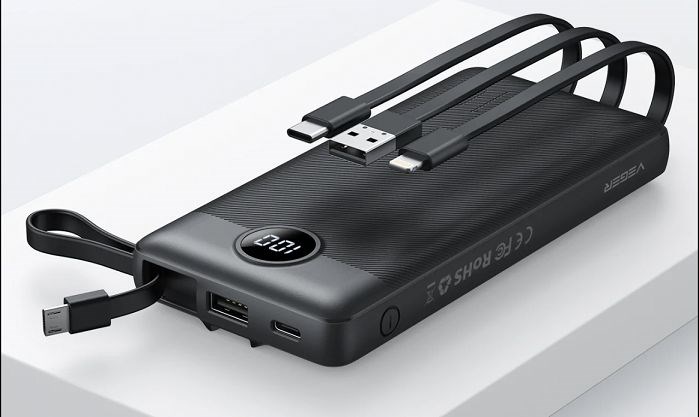
The choice of power bank needs to be well made. A poor selection leads to poor or unreliable performance, a slow charge or even safety hazard. In order to make sure that your power bank should perfectly hold your requirements and work in a safe way, you should first of all pay attention to these seven key aspects: the capacity, the power output, the ports that the power bank should have, the quality you should pay attention to, the safety certifications, the size and weight of this device and finally its reputation. These are some of the aspects that are needed to buy a quality power source that will provide reliable energy when the power is needed.
Assess Your Device's Power Needs
In order to determine the power requirements of your device to a power bank, you should determine the battery capacity (mAh) of your device and daily power demand. For several full chargings, compute the number of full charges you need. Set this requirement to the effective capacity of a power bank (take as actual output ~60-70%) Make sure the output wattage and voltage of the power bank covers the charging protocols of your device. Charging several devices at the same time may also be included.
Prioritize Portability vs. Capacity
An underlying trade-off is placing an importance on portability over capacity. Greater mAh gives lots of charges, however, size and weight are high. The smaller capacity options are slimmer and easier to carry as they increase mobility even on a daily basis. The best comparison is determined by how you use it. Regular travellers mostly value the convenience of portability that will allow them to accept lower full charges within a single cycle. Consult your average requirements with the aim of determining whether you want the most power or most convenient carrying.
Check Output Speed & Technology
Make sure the output speed of the power bank (watts/amps) is compatible with your device. Make sure that it supports fast charging (wattage/amperage). Any fast-charging protocol (such as USB Power Delivery or Qualcomm Quick Charge) confirmed as compatible by your device will work correctly with your device. Have these technologies supported using compatible cables.
Verify Input Charging Speed Too
Look at the power bank input charge capability (watts (W) or amperages (A) at a certain voltage (V). This will be the speed at which this power bank charges. Ensure the input speed given by the manufacturer. Make sure that your wall charger and cable can supply this necessary wattage to reach the promising recharging rate. Great input speeds lower the length of time taken to recharge the power banks. When using a charger, make sure that the output of that charger is equivalent to the input requirement of the power bank.
Ensure Essential Safety Certifications
To buy a power bank, make sure that it has necessary safety certifications. Give preference to those units that are certified according to certain well-known standards such as UL 2056, CE, FCC, RoHS, and PSE (in Japan). These certification checks ensure that the device is of high safety mechanisms against overheating, short-circuiting, overcharging, and electric shocks. Compulsory compliance implies strict testing with regard to user safety.
Choose Reputable Brand Reliability
It is a guarantee of the power bank by choosing a trademark that has decent feedback. Brands that have been established are strict with regard to quality control in the manufacturing process. They acquire the critical safety-related certification such as UL or CE. Good brands give their capacity ratings accurately. This will reduce chances of performance and safety caused by charging your devices.
Consider Additional Features Wisely
At the time of making a purchase with a power bank, look with a serious eye at the additional features in relation to real needs and budget. Also, do not pay a much higher price on the features you do not actually use in your day-to-day life, e.g., wireless charging when your equipment is not compatible. Choose realistic accessories such as extra charging ports to charge more than one phone at a time or USB-C Power Delivery when the devices can run fast charging. Mean-enough features should add real value to utility without inappropriately increasing cost.
Conclusion
When choosing a good power bank, one needs to consider aspects. The capacity (mAh) should be according to the requirement of your device. And output current (Amps) should be able to satisfy the charging needs of the device. Your cables have to be compatible with port types (USB-C, USB-A). Portability depends on size and weight with regard to capacity. Quality of the buildings determines endurance. Vital safety approvals (CE, FCC, UL) cannot be neglected at all. Focus more on well established brands that are reliable. When you apply these seven criteria your power bank will be efficient, safe and reliable in charging. No sacrificing performance, safety or value. On these technical and safety fundamentals alone make your choice.


Leave Comment